
What Do I Need to Open a Shopify Store in Chile (SII, Receipts & Billing)
Updated
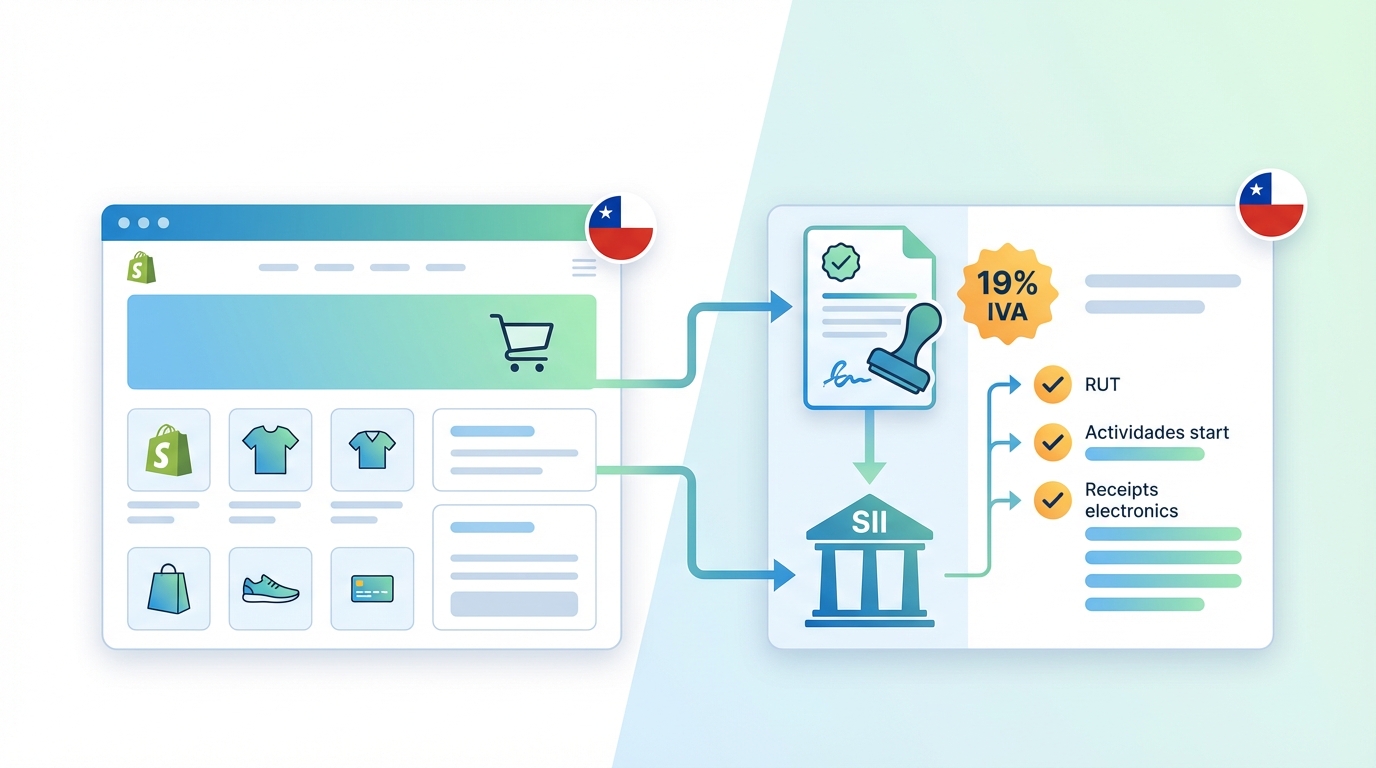
Opening a Shopify store is relatively quick. The complex part comes when the question is: "What do I need to sell legally in Chile, issue receipts/invoices, and properly configure taxes?"
In Chile, any e-commerce that sells on a regular basis must:
- Be formalized with the Servicio de Impuestos Internos (SII — Chilean tax authority).
- Issue valid electronic receipts or invoices.
- Properly configure the 19% VAT and their billing system.
This article summarizes the minimum requirements for an SMB that wants to sell on Shopify while complying with the basic rules. It does not replace tax or accounting advice; take it as a general roadmap to know what to ask your accountant.
Before Opening Your Shopify Store: What You Need to Know in Chile
Quick answer: To open a Shopify store in Chile you need your business formalized with the SII (RUT and activity start-up), be enabled as an electronic receipt or invoice issuer, and connect to a valid billing system (free SII portal or authorized software). Additionally, you must configure the 19% VAT in Shopify and decide whether to display prices with taxes included or excluded.
What This Article Covers (Scope and Limitations)
Here we focus on three things:
- Minimum requirements with the SII to sell online.
- How to handle electronic receipts/invoices if you use Shopify.
- Key points for tax configuration on the platform.
We won't talk about store design or commercial strategy — only about what can get you in trouble if you ignore it.
Why It's Not Enough to "Just Open the Store"
Anyone can open a Shopify store with a credit card. The SII is a different story.
If you sell without:
- Activity start-up registration.
- Electronic receipts/invoices.
- Properly managed VAT.
You're leaving a digital trail (payments, transfers, gateways, banks) that the SII can cross-reference at any time. The idea is to start right and sleep well from day one.
Formalizing Your Business with the SII: RUT, Activity Start-Up, and Business Activity
RUT and Activity Start-Up with the SII
To issue valid tax documents in Chile, you need:
- RUT (as an individual with a business activity or as a legal entity).
- Activity start-up with the SII under the corresponding business activity (commerce, online sales, etc.).
This procedure is done online at sii.cl and declares that your business is starting to generate taxable income.
Business Type and Activity Associated with E-commerce
You can sell as:
- Individual with a business activity (sole proprietorship).
- EIRL, SpA, Ltda, etc.
What matters for the purposes of this article:
- That the business activity includes the actual commercial activity (e.g., "online retail sales").
- That your accountant advises you on the appropriate tax regime.
Implications of Paying First Category Taxes
If you're going to issue receipts/invoices for regular sale of goods or services, you'll operate under First Category (business income).
This means:
- Declaring and paying VAT (F29).
- Filing annual income tax (F22).
- Keeping a record of purchases and sales.
In Shopify, everything you sell must match your billing system and your tax filings.
Electronic Receipts and Invoices: Requirements and Options for E-commerce
Mandatory Electronic Receipts and Basic Requirements
In Chile, electronic receipts are mandatory for all taxpayers since 2021, with very few special exceptions.
To issue electronic receipts you need:
- Active activity start-up with the SII.
- Be enabled as an electronic receipt issuer, either using the free SII system or authorized third-party software.
What a Valid Electronic Receipt Must Contain
By regulation, an electronic receipt must include at least:
- Company legal name.
- Taxpayer RUT.
- Electronic receipt number.
- Issue date.
- Total transaction amount.
- VAT amount.
Optionally, it can detail the products and carry the SII's electronic stamp.
Issuing Options: SII Portal vs. Billing Software
You have two paths:
1. Free SII Portal
- Sufficient at the beginning if sales volume is low.
- Requires issuing each receipt/invoice manually, copying data from each order.
2. Integrated Software (Relbase, Bsale, etc.)
- They connect with your Shopify store to automatically issue electronic receipts/invoices.
- Receipts are recorded in the system and reported to the SII as DTE.
- Saves time, reduces errors, and organizes your books.
If your plan is to sell seriously, the practical path is some type of integration — not issuing everything manually.
How to Connect Your Shopify Store with Your Receipt/Invoice System
Manual Workflow: When It Makes Sense and Its Limitations
Typical workflow at the beginning:
- Shopify records the order and payment.
- During the day or periodically, you log into the SII portal or your billing system.
- Issue a receipt/invoice associated with the order.
- Send the document to the customer (PDF, email, etc.).
Problems with Manual Workflow
It's easy to make mistakes with amounts or RUT, you waste time you could invest in selling, and if you miss receipts, you expose yourself to SII observations.
Automatic Integration with Billing Software
The scalable alternative is to connect Shopify with a billing system that:
- Automatically receives orders from Shopify (via API/webhooks).
- Issues the electronic receipt or invoice at the time of sale.
- Sends the document to the customer and reports to the SII.
Providers like Relbase, Lioren, Nubox, Bsale, among others, offer specific integrations for e-commerce.
What to Check Before Choosing an Integration (DTE, Support, Costs)
Before choosing:
- Confirm that the software is authorized to issue valid DTE (electronic receipts and invoices) with the SII.
- Check that it has official integration or documented support for Shopify.
- Evaluate monthly and per-document costs, support quality in Chile, and contingency plans.
Tax Configuration in Shopify for Chile
19% VAT: How to Set It Up in Shopify
In Shopify you must:
- Go to Settings > Taxes and duties.
- Select Chile and enable sales tax collection.
- Make sure the national tax is 19%, which corresponds to the Chilean VAT.
This makes Shopify automatically calculate 19% on taxable products.
Prices with VAT Included or Excluded: Consistency with the SII
You have two options:
- Display prices with VAT included (most common in B2C).
- Display net prices and add VAT at checkout (more common in B2B).
Important
What you show the customer must be consistent with how you declare and issue receipts/invoices. If your prices "include VAT," your billing system must correctly separate net + VAT on each document.
Shopify, Subscription VAT, and Your Taxpayer RUT
In addition to your sales, Shopify services (subscription, apps) may carry 19% VAT if your store is in Chile.
If you enter your RUT in Shopify's billing profile and you're a VAT taxpayer, your invoices could be exempt from Chilean VAT on those services, according to Shopify's current policy (we recommend consulting with your accountant).
Minimum Checklist Before Launching Your Shopify Store in Chile
- ✓ RUT and activity start-up with the SII under the correct business activity.
- ✓ Enabled as an electronic receipt/invoice issuer (free SII or external software).
- ✓ Decision made: Manual issuance (low volume) or automatic integration.
- ✓ Shopify configured with 19% VAT on national taxes.
- ✓ Defined whether you'll display prices with VAT included or not (aligned with billing).
- ✓ Tested at least one complete cycle: Order, receipt issuance, and delivery to customer.
With this, you don't just have "a nice-looking store" — you have an e-commerce that can operate legally and scale without basic tax headaches.
Questions About Billing in Shopify
Can I sell on Shopify in Chile without issuing electronic receipts or invoices?
No. If you make regular sales, you must issue valid tax documents to the SII. Electronic receipts are mandatory for virtually all taxpayers.
Is it mandatory to have integrated billing software?
It's not mandatory, but highly recommended. You can use the free SII portal if you sell little, but software automates the process and prevents errors.
Does Shopify connect directly with the SII?
Not natively. You need a "bridge" or integration through software like Relbase, Lioren, Nubox, Bsale, etc.
Ready to Launch Your Shopify Store in Chile?
We help you with the entire setup: configuration, billing, payment gateways, and conversion optimization.