
Event-based email campaigns: how to create emails that feel human and sell
Updated
Event-based emails work when they feel like a real message tied to a real moment—not a forced marketing stunt wearing a costume. The best ones make you think "oh, good timing" instead of "oh, another brand trying to be clever." This playbook breaks down how to build those emails from scratch: structure, tone, segmentation, and a pre-send checklist so you never hit "Send" on something cringe.
What is an event-based email and why does it work?
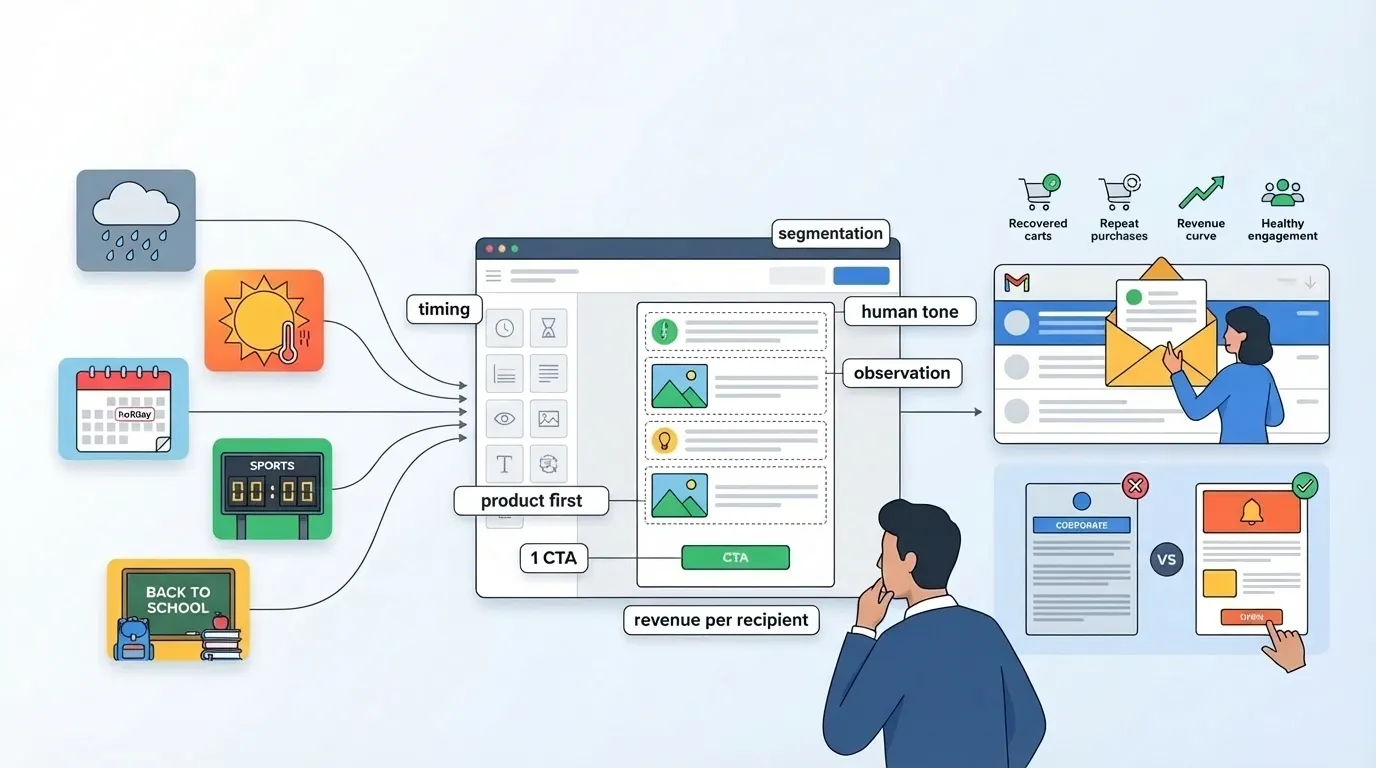
An event-based email is a marketing message sent around a real, relevant moment—a weather shift, a holiday, an election, a sports match—to connect naturally with your audience. It works because it piggybacks on something people already care about, which makes your message feel timely instead of random. When done right, it lowers the mental barrier between "I'm reading a marketing email" and "this brand gets me."
1 Start with moments people already care about
The whole point is to ride a wave that already exists, not create one. Look for:
- Weather shifts: first cold front, heat wave, rainy weekend ahead.
- Elections and civic events: people are already thinking, feeling, deciding.
- Sports matches: local derbies, World Cup games, playoffs.
- Long weekends and holidays: everyone's already planning.
- Cultural moments: back to school, summer break, tax season.
2 Use a "message-first" structure
Most event emails fail because brands jump to the product too fast. Try this 5-part structure instead:
The "message-first" structure:
- Hook: Reference the moment directly. "Tomorrow's going to be brutal."
- Observation: Say something true and relatable. "The kind of day where nothing sounds good except staying under the covers."
- Useful tip: Offer genuine value, even if they don't buy. "If you're going out, layer up. Thermal base + windbreaker beats a heavy coat."
- Product bridge: Now—naturally—connect to what you sell. "Our merino base layer was built for days like this."
- CTA: Keep it simple. One link. One action. "Grab one before the cold hits →"
The key: the reader should feel like the email would still be worth reading even without the product mention. That's when you know the structure is right.
3 Keep the brand voice human, not "campaign voice"
Event-based emails need to sound like a person wrote them on that specific day. Not like a template with a date swapped in. Here's how:
- Short sentences. No paragraph should need a scroll.
- Simple words. "Hot day" beats "elevated temperatures."
- Natural humor only. If the joke doesn't make you smile, delete it.
- First person is fine. "We're closing early on Friday" feels real.
4 Use the product as a "natural next step," not the main event
The moment leads. Your product follows. Think of it as: the event is the headline, your product is the footnote that happens to be useful.
Bridge examples:
- "Long weekend coming up?" → Your travel kit.
- "Election day is tomorrow." → Your comfort food / self-care products.
- "It's going to hit 38°C today." → Your lightweight gear or cold drinks.
- "Match starts at 9pm." → Your snack box / game-day merch.
Need ideas for building these campaigns inside a real tool? Check out our guide on creating your first campaign in Omnisend.
5 Make segmentation your safety net
Segmentation is what separates a relevant email from an annoying one. For event-based sends, filter by:
Recommended Filters
- ✓ Location (weather, local events)
- ✓ Engagement (active openers first)
- ✓ Product interest (past purchases)
- ✓ Customer status (new vs. returning)
Common Mistakes
- × Sending to the full list every time
- × Ignoring time zones
- × No exclusion for recent purchasers
- × Skipping engagement filters
When in doubt, narrow the audience. A smaller, more relevant send always beats a big, sloppy blast.
6 Keep the design intentionally simple
Event emails should look like they were written that morning—because the best ones are. Overdesigned templates kill the "real moment" feel.
- One hero image or meme (optional). If it adds nothing, skip it.
- Minimal text. If you can't say it in 150 words, you're overcomplicating it.
- Two links max in the body.
- One CTA button. One. Not three with different colors.
7 Write subject lines like a real notification
Your subject line competes with texts, Slack pings, and app notifications. It should feel like one of those—not like a marketing email.
| Generic (skip this) | Event-based (do this) |
|---|---|
| "Winter Sale! Up to 50% Off!" | "Tomorrow's going to rain." |
| "Don't Miss Our Election Day Deal!" | "Election day heads-up." |
| "Beat the Heat with Our Summer Collection!" | "Hot day today—quick reminder." |
| "Exclusive Game Day Offer Inside!" | "Match starts at 9. You ready?" |
Notice the pattern: the good subject lines sound like a friend texting you. No exclamation marks. No ALL CAPS. No "exclusive" or "don't miss."
8 Measure results like a performance marketer
Don't judge event emails by opens alone. Opens tell you the subject line worked. They don't tell you if the email made money. Track:
Clicks (and where they clicked—CTA vs. inline link vs. image)
Purchases and revenue attributed to the send
Revenue per recipient (your north star for event emails)
Unsubscribe and complaint rate (your canary in the coal mine)
Reply volume if you invite replies (high replies = high trust)
If you're not tracking revenue per recipient, you're guessing. And guessing doesn't scale. If you're also running abandoned cart strategies, compare performance side by side to understand the full picture.
! Don't overuse it
The golden rule: event-based emails are seasoning, not the whole meal.
If every email you send becomes a "moment email," it stops feeling special and starts feeling like a brand trying too hard to be relatable. Your email calendar should still include:
- Welcome flows for new subscribers
- Abandonment automations for cart and browse recovery
- Promotional sends for actual sales and launches
- Educational emails that build trust over time
Event-based emails should be 1–2 per month, sprinkled in between your core flows. They're the ones that make subscribers think "this brand actually pays attention." That's the power. Don't dilute it.
For a deeper dive into why email matters for small businesses in the first place, read why email marketing is the most undervalued asset for SMBs.
Our pre-send checklist
Before you hit "Send," ask yourself:
Is the moment still relevant? If it's already passed or the forecast changed, kill the send.
Would I forward this to a friend? If no, the tone needs work.
Is the segment tight enough? When in doubt, narrow it.
Does the product mention feel natural? Read it without the product line. Does the email still make sense?
Is the subject line under 50 characters? Shorter = more notification-like.
Have I checked for sensitivity? Elections, tragedies, and polarizing events need extra care.
Is there only one CTA? One link, one action. That's it.
Frequently Asked Questions
What is an event-based email?
It's a marketing email sent around a real, relevant moment (weather, holiday, sports match, elections) to connect naturally with your audience, instead of sending a generic promotion.
How often should I send event-based emails?
No more than 1–2 per month. If every email becomes a "moment email," it stops feeling special and starts feeling like a brand trying too hard to be relatable. Use them as seasoning, not the whole meal.
Do I need to segment for event-based emails?
Yes, segmentation is your safety net. Filter by location (weather emails only where applicable), engagement (active subscribers first), product interest, and customer status. When in doubt, narrow the audience instead of going wide.
What metrics should I track for event-based emails?
Don't judge them by opens alone. Track clicks (and where they clicked), purchases and revenue, revenue per recipient, unsubscribe and complaint rate, and reply volume if you invite replies.
Want to implement email marketing that actually sells?
We build event-based campaigns, automations, and full email strategies for brands that want real results—not vanity metrics.